Thermocouples are widely used to measure temperature across all industries.
A thermocouple consists of two conductors produced from dissimilar metals. One end of the conductor pair is formed into a junction (the hot junction) and placed in the area to be measured. The other end of the conductor pair (the cold junction) is connected to the measuring instrument. When the two junctions are at different temperatures a small electromotive force (emf) is created. This is known as the ‘Seebeck effect’, discovered by the German physicist Thomas Johann Seebeck in 1821.
The relationship between temperature and output (mV) is predictable and so by measuring the output the temperature can be determined.

There are several different thermocouple types in use, and they are identified with standard thermocouple colour codes, as in the table below.
| Thermocouple Types and Properties | ||||
|---|---|---|---|---|
| Type | Conductors (+ve/-ve) Max Temp* | IEC Thermocouple Colour Code | BS (old) Thermocouple Colour Code | |
| J | Iron/ Constantan 750°C |  |  | Type J used in dry/reducing conditions For lower temperatures than Type K + leg magnetic |
| K | Nickel Chromium/ Nickel Aluminium 1200°C |  |  | Type K is the most commonly used thermocouple. Economic and used across a wide temperature range. -ve leg is magnetic |
| T | Copper/ Constantan 350°C | 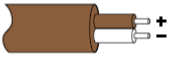 |  | Type T is accurate -40 to 300°C Used in pharma applications and moist conditions |
| E | Nickel Chromium/ Constantan 900°C | 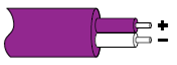 |  | Type E has strong mV output and stable at higher temperatures than type K |
| N | Nicrosil/ Nisil 1200°C | 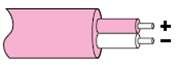 |  | High stability and resistance to oxidation at high temperatures |
| R | Platinum-13% Rhodium/ Platinum 1600°C |  |  | Noble metal. For high temperatures, oxidising or inert conditions |
| S | Platinum-10% Rhodium/ Platinum 1600°C |  |  | Nobel metal. For high temperatures, oxidising or inert conditions |
| B | Platinum-30% Rhodium/ Platinum-6% Rhodium 1700°C | 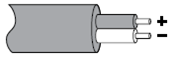 | Nobel metal. For very high temperatures, oxidising or inert conditions | |
* Max temperature is dependant on conductor size, insulation material and environment
The detectors would normally be incorporated into a temperature probe assembly, see ‘what are the main types of temperature probes?’ above.